Course Solutions Uncategorized (Solved) : Leat Difusion Rod Tine Aubplet 21 1 Class Tre Learned Amalytical Solatson D Beat Equation Q35717433 . . . .

(Solved) : Leat Difusion Rod Tine Aubplet 21 1 Class Tre Learned Amalytical Solatson D Beat Equation Q35717433 . . . .


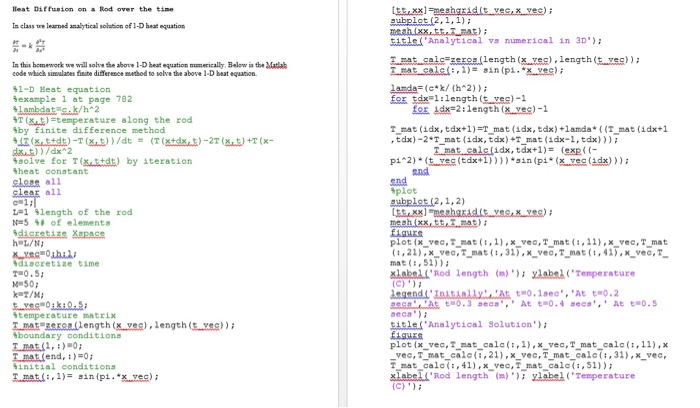
leat Difusion on a Rod over the tine aubplet (2.1,1) In class tre learned amalytical solatson of I-D beat equation titlsAnalmedia%2F15e%2F15e9cad4-5803-4ecb-a7e2-67leat Difusion on a Rod over the tine aubplet (2.1,1) In class tre learned amalytical solatson of I-D beat equation titls’Analytical va numerical in 3D) In this homework we will sove he aboe 1-D beat equation mumecically. Below ia the Mata eode which simulates fiite difference method to solve the above 1-D beat equation at cals zsealength (x yeg),length(tes) mat salel1)sin (pi.xxee) 1-D Heat equation Sexample 1 at page 782 for tdx=1: length (LOSS)-1

OR

PayPal Gateway not configured

OR

PayPal Gateway not configured

Leave a Reply

Your email address will not be published. Required fields are marked *

Related Post

(Answered):I Need To Write A 5 Page Paper On A Type Of Discrimination In Apa Format Directions Are Stated Below . . . .(Answered):I Need To Write A 5 Page Paper On A Type Of Discrimination In Apa Format Directions Are Stated Below . . . .

MIDTERM PAPERDiscrimination by TypeAgeDisabilityEqual Pay/CompensationGenetic InformationHarassmentNational OriginPregnancyRace/ColorReligionRetaliationSexSexual HarassmentSelect and Research ONE of the various types of discrimination prohibited by the laws enforced by EEOC. Provide:1.The most recent and relevant law

(Answered) : Suppose analysis of a random sample results in an “in control” determination. Which of the following statements is most appropri(Answered) : Suppose analysis of a random sample results in an “in control” determination. Which of the following statements is most appropri

Suppose analysis of a random sample results in an "in control" determination. Which of the following statements is most appropriate? A. While non-random variation could be affecting the process, we have

(Solved) : Consider Following Graph Information Cascade Use Independent Cascade Model Find Nodes Get Q37196518 . . . .(Solved) : Consider Following Graph Information Cascade Use Independent Cascade Model Find Nodes Get Q37196518 . . . .

<p><img alt="Consider the following graph of information cascade. Use the Independent Cascade Model to find which nodes will get activated" src="https://media.cheggcdn.com/media%2F778%2F778c2b19-dbaa-4ec9-a39d-8bc8692b7b96%2FphpARB4ae.png" style="height:370px;width:723px;" aria-describedby="d3f"/></p>Consider the following graph of information cascade. Use