Course Solutions Uncategorized (Solved) : Des Data Encryption Standard Complete Question Following S Boxes P Box Permutations Q35888205 . . . .

(Solved) : Des Data Encryption Standard Complete Question Following S Boxes P Box Permutations Q35888205 . . . .


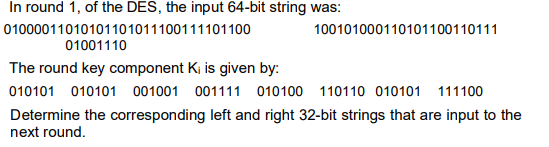
In round 1, of the DES, the input 64-bit string was: 01000011010101101011100111101100 100101000110101100110111 01001110 The r

DES (Data Encryption Standard): Complete the above question, andthe following S-Boxes and P-Box Permutations.
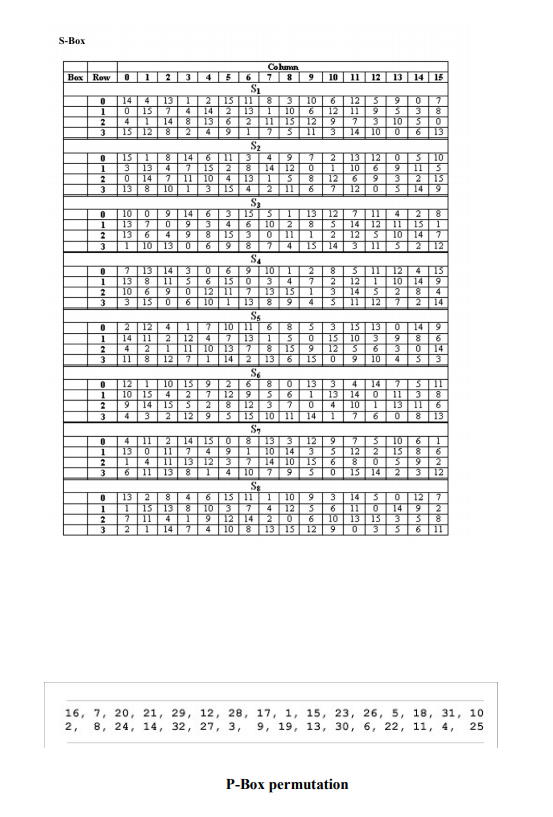
S-Box 16, 7, 20, 21, 29, 12, 28, 17, 1, 15, 23, 26, 5, 18, 31, 10 2, 8, 24, 14, 32, 27, 3,9, 19, 13, 30, 6, 22, 11, 4, 25 P-B

In round 1, of the DES, the input 64-bit string was: 01000011010101101011100111101100 100101000110101100110111 01001110 The round key component Ki is given by: next round. S-Box 16, 7, 20, 21, 29, 12, 28, 17,

OR

PayPal Gateway not configured

OR

PayPal Gateway not configured

Leave a Reply

Your email address will not be published. Required fields are marked *

Related Post

(Solved) : 32 Bit Mips Machine Need Execute Following Single Precision Floating Point Arithmetic Inst Q29052951 . . . .(Solved) : 32 Bit Mips Machine Need Execute Following Single Precision Floating Point Arithmetic Inst Q29052951 . . . .

<p>On a 32-bit MIPS machine, you need to execute the followingsingle-precision floating point arithmetic instructions:</p><p>1.)        3.5e25 * 3.5e25 /12.0e20</p><p>2.)        13.2e-30 *3.5e25</p><p>3.)        13.2e-20 / 3.5e25+ 5.7e8</p><p>Do any of the above operations

(Solved) : Exercise 551 Compute Hubbiness Authority Nodes Original Web Graph Fig 51 Could Provide Sol Q38270596 . . . .(Solved) : Exercise 551 Compute Hubbiness Authority Nodes Original Web Graph Fig 51 Could Provide Sol Q38270596 . . . .

<p><img alt="Figure 5.1: A hypothetical example of the Web" src="https://media.cheggcdn.com/media%2F67b%2F67b3548f-2002-4350-b519-16b4b5afd79f%2FphphkHiFE.png" style="height:418px;width:590px;" aria-describedby="d3f"/></p><p>Exercise 5.5.1 : Compute the hubbiness and authority of each ofthe nodes in<br/>our original Web graph of Fig. 5.1.</p><p><strong>Could