Course Solutions Uncategorized (Solved) : Formulate Single Sql Query Produce Requested Information Display Columns Requested Sure Qu Q37763998 . . . .

(Solved) : Formulate Single Sql Query Produce Requested Information Display Columns Requested Sure Qu Q37763998 . . . .


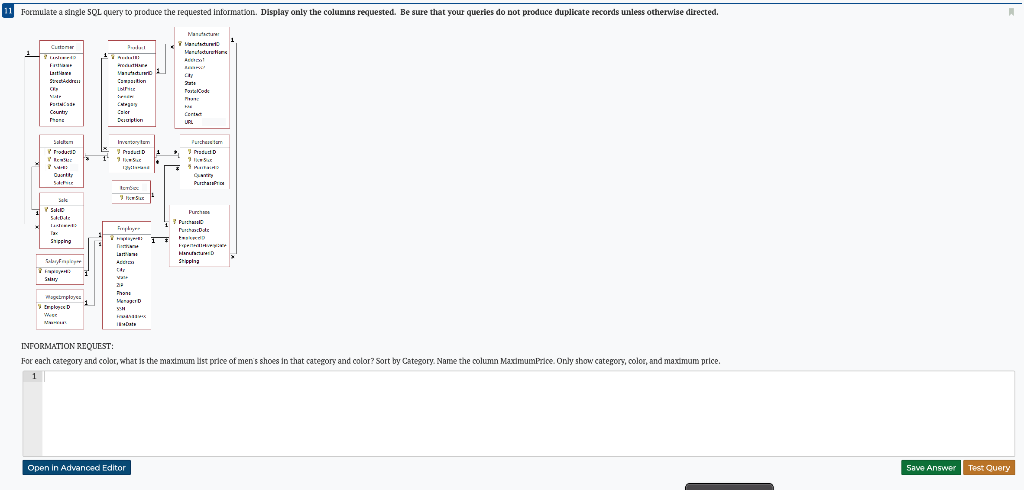
Formulate a single SQL query to produce the requestedinformation.  Display only the columns requested.Be sure that your queries do not produce duplicate records unlessotherwise directed:

INFORMATION REQUEST:

For each category and color, what is the maximum list price ofmen’s shoes in that category and color? Sort by Category. Name thecolumn MaximumPrice. Only show category, color, and maximumprice.
Formulate a single sQL query to produce the requested latomation. Display oaly the columins requested. Be sure that you querl

Formulate a single sQL query to produce the requested latomation. Display oaly the columins requested. Be sure that you querles do Bot produce duplicate

OR

PayPal Gateway not configured

OR

PayPal Gateway not configured

Leave a Reply

Your email address will not be published. Required fields are marked *

Related Post

(Solved) : Consider Following Er Diagram Construct Relational Database Schema Corresponding Er Diagr Q35571236 . . . .(Solved) : Consider Following Er Diagram Construct Relational Database Schema Corresponding Er Diagr Q35571236 . . . .

<br/><img src="https://media.cheggcdn.com/media%2F029%2F029cec47-020e-4831-9ab6-4ce529aa5558%2Fimage.png" alt="I. Consider the following ER-Diagram: Construct a relational database schema corresponding to the ER-diagram and specify prim" aria-describedby="d3f"/>I. Consider the following ER-Diagram: Construct a relational database schema corresponding

(Solved) : Find Asymptotic Runtimes Following Divide Conquer Algorithms Using Master Theorem 1 2 Q30111126 . . . .(Solved) : Find Asymptotic Runtimes Following Divide Conquer Algorithms Using Master Theorem 1 2 Q30111126 . . . .

<p>Find the <strong>Asymptotic runtimes</strong> of the followingdivide and conquer algorithms using <strong>MasterTheorem</strong>:</p><p>1.  <img alt="T(n) = 5T(n/3) + n! +21" src="https://media.cheggcdn.com/media%2F5d2%2F5d213e23-88e0-43ff-96b1-af5df3f52548%2F41329b8d-cba5-4004-8f26-ec9bb5eb94ac.gif" aria-describedby="d3f"/></p><p>2.  <img alt="T(n) = 2T(n/2) + 4n" src="https://media.cheggcdn.com/media%2Fd59%2Fd59b963e-c9eb-4610-b796-34e604850466%2F1e0a1aca-5153-473b-b248-ba6d47310e01.gif"/><img alt="log(n)" src="https://media.cheggcdn.com/media%2Fbaf%2Fbafa81b7-bb8b-460a-a0a2-4d2ec71a6593%2Fc475cff0-a1f7-4f91-9411-a1ec923f1c68.gif"/></p>T(n) = 5T(n/3)