Course Solutions Uncategorized (Solved) : Matlab Program Particle Path Described Terms Time T Following Functions X T 2 Cos T Y T 13 Q27014713 . . . .

(Solved) : Matlab Program Particle Path Described Terms Time T Following Functions X T 2 Cos T Y T 13 Q27014713 . . . .


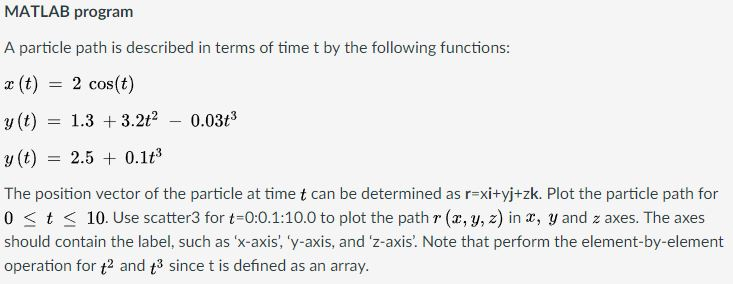
MATLAB program A particle path is described in terms of time t by the following functions: x (t) = 2 cos(t) y (t) = 1.3 + 3.2f!-0.03t3 y(t) = 2.5 + 0.1f The position vector of the particle at time t can be determined as r-xityj+zk. Plot the particle path for 0 t 10. Use scatter3 for t-0:0.1:10.0 to plot the path r (x, y, z) in , y and z axes. The axes should contain the label, such as x-axis, y-axis, and z-axis. Note that perform the element-by-element operation for t and t3 since t is defined as an array.

Please

OR

PayPal Gateway not configured

OR

PayPal Gateway not configured

Leave a Reply

Your email address will not be published. Required fields are marked *

Related Post

(Solved) : Consider Relational Database Student Sid Sname Gpa Sizehs Apply Sid Cname Major Decision C Q32478801 . . . .(Solved) : Consider Relational Database Student Sid Sname Gpa Sizehs Apply Sid Cname Major Decision C Q32478801 . . . .

<p>Consider the Relational Database:<br/>STUDENT [<strong>sID</strong>, sName, GPA, sizeHS]<br/>APPLY [ <strong>sID</strong>, <strong>cName</strong>, Major,Decision]<br/>COLLEGE [<strong>CName</strong>, State]</p><p>where APPLY.sID REFERENCES STUDENT.sID and APPLY.cNameREFERENCES COLLEGE.CName</p><p>Using SQL queries to find:</p><p>a. The list of students who applied
(Solved) : 1411116 Programming Quiz 1 Section 51 Fall 2018 19 Name Id Qi Choose Appropriate Answer 1 Q31281256 . . . .(Solved) : 1411116 Programming Quiz 1 Section 51 Fall 2018 19 Name Id Qi Choose Appropriate Answer 1 Q31281256 . . . .

q1 and q2 please c++ course<br/><img src="https://media.cheggcdn.com/media%2Fb60%2Fb603b703-99c5-43a2-84fa-bfaad4c1968b%2Fimage" alt="1411116: Programming I Quiz # 1 Section: 51 Fall 2018-19 Name and ID Qi . Choose the appropriate answer 1. For what value